
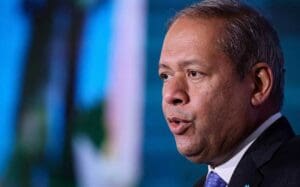

Barclays is turning to artificial intelligence to power the next phase of its turnaround, as the bank targets around £2 billion of cost savings and commits to returning more than £15 billion of surplus capital to shareholders by the end of 2028.
C.S. Venkatakrishnan, the chief executive, widely known as Venkat, said the bank would pursue about £2 billion of gross efficiency savings over the next three years, alongside increased investment in technology, including AI, to improve productivity and customer experience.
“We will invest further to improve customers’ experience and deepen relationships, while harnessing new technology, including AI, to improve efficiency and build segment-leading businesses and drive further growth,” Venkat said.
The commitments form part of a new set of three-year targets unveiled alongside Barclays’ full-year results, marking the next stage of a restructuring that has already delivered a sharp re-rating of the bank’s shares.
Under the plan, Barclays expects to hand back more than £15 billion of excess capital to investors by the end of 2028, reflecting stronger profitability and capital generation across the group.
The announcement comes two years after Venkat launched an overhaul of Barclays aimed at reducing reliance on its volatile investment banking arm and rebalancing the business towards more stable earnings from UK retail, corporate and private banking.
That strategy has faced setbacks on the M&A front. Barclays lost out to Santander UK last summer in the £2.65 billion auction for TSB, and earlier this week was beaten by NatWest in the race to buy wealth manager Evelyn Partners for £2.7 billion.
Despite those frustrations, the turnaround has been well received by investors. Barclays shares have risen by around 240 per cent over the past two years, one of the strongest performances among major UK banks.
The group’s annual results underlined that momentum. Pre-tax profits rose 13 per cent to £9.1 billion last year, comfortably ahead of the £9 billion forecast by City analysts.
Barclays also announced £1.8 billion of capital returns for the year, including an £800 million full-year dividend — equivalent to 5.6p a share — and up to £1 billion through a share buyback.
With its initial restructuring largely complete, Barclays is now betting that tighter cost control and the smarter use of AI can sustain growth, improve returns and cement its recovery as competition across UK and global banking intensifies.
Read more:
Barclays to lean on AI as it targets £2bn cost cuts and £15bn capital return